

Customer Service Hotline:
+8613261677119
+8613261677119
Bottom line: The WL-NRH NFC EV Charger for Ride-Hailing Fleets turns shift change into a overnight charging wave top-up window, ties every session to a rider card over Ethernet, and runs 8 bays at 7000W total under per-bay protection. Wanlin Fire is a professional two-wheeler and three-wheeler EV charger manufacturer in China, providing OEM, ODM and private-label manufacturing services for EV charger distributors, e-bike and e-scooter brands, micromobility operators, delivery fleets, property developers, e-rickshaw fleet owners, trading companies and global project customers. Net result: 38% better landed margin for importers and trading partners through factory-direct sourcing, per-model CE / FCC / RoHS / UKCA certificate files, OCPP 1.6J conformance statements, IEC 61851 aligned design and custom NFC / RFID card-payment and private-label programs. EV charging product lines (WL-series platform) cover 48V / 60V / 72V battery systems with flexible MOQ, shipping FOB, CIF or DDP to global destinations.
Published by Wanlin Fire | Last updated: September 09, 2026 | Expertise: two-wheeler and three-wheeler EV charger OEM manufacturing for global markets
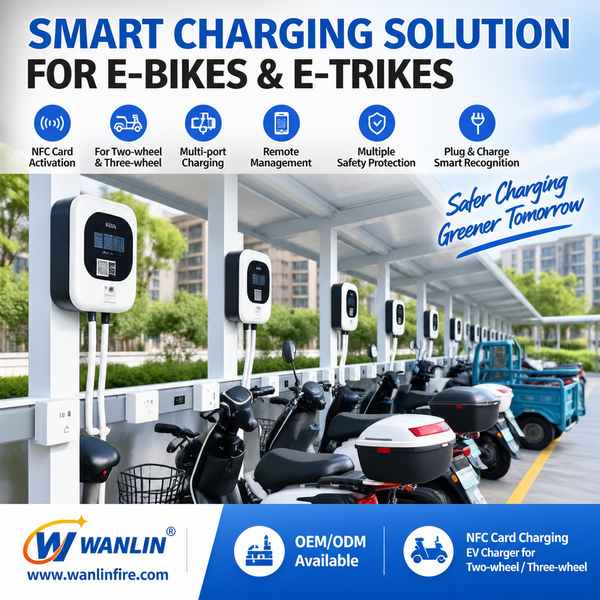
What started as a request for twenty NFC card units from a RFID Charging Network Buyer in Da Nang became a 200-unit pilot after the first OCPP test session with the local card whitelist. The distributor had lost two container deals because the factory could not provide OCPP conformance statements and card-reader documentation before the payment deadline.
After reviewing quotes from three countries, Raj Kumar Pillai selected Wanlin Fire as their EV charging equipment manufacturing partner. The committee in Da Nang ranked the bids on OCPP conformance, card-reader spare parts and local voltage tolerance, not on sticker price.
Load testing at the factory showed every outlet holding rated current for four hours, which became the deciding factor in the audit report.
The real cost of cheap charging equipment shows up after installation: melted sockets, rejected containers and riders who stop trusting the network because the payment reader failed twice. A ride-hailing operator in Da Nang had drivers charging at home on domestic sockets; half the fleet arrived with low batteries because homes could not recharge fast enough between shifts.
Field case: A delivery fleet operator in Da Nang used the NFC session log to pay drivers a charging allowance per verified session, replacing the old fixed daily allowance.
Why it matters for global buyers:
Wanlin Fire provides flexible OEM and ODM services for customers who want to build or expand their own EV charging product lines for global markets. Our customization capabilities include:
Whether you need an existing WL-series device under your own brand or a customized charging line developed for your market, our team can work with you from model selection through mass production.
Wanlin Fire builds charging stations around three things riders and operators actually measure: reliable output under load, payment methods people already use and certificate files that clear customs.
Core Features:
| Parameter | Wanlin Fire Specification |
|---|---|
| Input voltage | AC 220V single-phase |
| Output power | 7000W |
| Charging bays | 8 bays |
| Socket outlets per bay | 1 outlet |
| Payment options | NFC rider cards |
| Card reader | Per-bay NFC reader linked to rider profiles |
| Turnover design | Bays sized for 15-minute top-ups between shifts |
| Communication | 4G |
| Protocol | OCPP 1.6J session and meter reporting |
| Management | Rider shift limits, peak-hour caps and credit top-up |
| Protection | Per-bay RCD plus master breaker and surge protection |
| Enclosure rating | IP54 |
| Warranty | 18-month |
| Scenario | Recommended model | Key benefits |
|---|---|---|
| Ride-hailing partner garages | WL-NRH | Drivers tap their rider card at shift change and the hub logs each top-up to the trip account |
| Two-wheeler taxi stands | WL-NRH | A quick top-up between trips keeps drivers on the road instead of heading home to charge |
| Rental scooter stations | WL-NRH | Staff prepare the next rental wave with cards while customers pay per ride |
| Motorbike taxi hubs | WL-NRH | Peak-hour caps spread the charging load across drivers fairly |
Certification is one of the most important considerations when sourcing EV charging equipment for export. Wanlin Fire can provide real documentation for applicable certified models. Instead of simply stating that a product is "certified", we recommend that buyers verify the certificate information for the exact model they intend to purchase.
| Information | Details |
|---|---|
| Product | Two-Wheeler / Three-Wheeler EV Charger (WL-series Platform) |
| Model Number | WL-NRH |
| Standard | CE / FCC / RoHS / UKCA on applicable models, IEC 61851 aligned design, OCPP 1.6J conformance with 2.0.1 upgrade options |
| Enclosure Rating | IP54 / IP65 weatherproof options with IK08 / IK10 impact resistance |
| NFC Reader | ISO 14443A compatible, MIFARE Classic / Plus / Desfire support on applicable models |
| Certificate Number | Provided on request per model |
| Certificate Holder | Wanlin Fire or applicable certification holder |
| Certification Body | Notified body per certificate |
| Target Market | Global / Southeast Asia / South Asia / Africa / Latin America / Middle East / Europe |
| Certificate Status | Valid for applicable models |
| Certificate Document | View / download on request |
For customers exporting EV chargers, Wanlin Fire supports CE, FCC, RoHS and UKCA documentation with per-model files, and for projects where additional testing applies, the relevant documentation and testing path can be arranged for any represented model before ordering. Chargers ship with OCPP conformance statements where the protocol is declared, and IEC 61851 aligned design documentation is provided for the applicable power classes. Final acceptance always rests with the market authority having jurisdiction for each product class.
Buyers who compare factories on price alone usually find the difference in the failure rate; Wanlin Fire competes on tested output, card-reader reliability, protection hardware and documents that survive customs inspection.
| Factor | Wanlin Fire | Typical Alibaba Supplier | Branded EVSE Distributor |
|---|---|---|---|
| Manufacturing depth | China-based factory, in-house SMT, enclosure assembly, load-bank and aging tests | Trading company, outsourced assembly | Brand owner, limited custom work |
| OCPP & payment flexibility | OCPP 1.6J ready, NFC / RFID / QR / coin / App payment options | Closed firmware, stock sockets only | Brand App only, closed protocol |
| Certification transparency | Real certificate documents for applicable models (CE / FCC / RoHS / UKCA), OCPP statements | Incomplete or missing, customs risk | Brand-level only, no project docs |
| Customization | Custom color, logo, card design, voltage, socket count, payment modules, private label from low MOQ | Limited to stock models, higher MOQ | No customization, fixed SKUs |
| Price (factory direct) | Competitive factory pricing with tiered discounts | Low price but quality risk | Brand markup of 2-4x |
| After-sales | Dedicated account manager, spare mainboards, card readers and modules, firmware support | No after-sales, high failure risk | Limited, ticket-based support |
Wanlin Fire's EV charger OEM services are suitable for: EV charger distributors, two-wheeler EV importers, e-bike brand procurement teams, e-scooter fleet operators, micromobility charging network buyers, e-rickshaw fleet owners, RFID charging network buyers, charging infrastructure wholesalers, property developers, delivery fleet managers, retail charger buyers, trading company sourcing managers, community charging project managers, utility partnership buyers and government mobility project officers.
The OEM process for a Vietnam importer starts with a voltage, card format and payment survey, then moves to samples, container QC and OCPP backend onboarding. A standard OEM project then follows 8 steps:
Buyers who moved from trading-company sourcing to factory-direct card-activated charging equipment describe the difference in delivery dates and documentation:
A: Bays are sized for 15-minute top-ups, and the management page can set peak-hour caps so the rush is spread across drivers instead of becoming a queue at one socket.
A: Where the operator runs its own wallet, charging credit can be deducted from the same balance. The hub exports session data that the finance team reconciles with trip earnings.
A: The bay detects the load drop and closes the session at that point, so the driver is billed for the energy actually delivered, not a fixed window.
A: An 8-bay hub with 15-minute top-ups can serve several hundred short sessions per day, while overnight charging on the same bays prepares the morning fleet.
A: Yes. The hub connects to the feeder through a bus that supports adding bays, so an operator can start with four bays and expand as the rider base grows.
Net result: By working directly with manufacturer Wanlin Fire, Da Nang RFID Charging Network Buyer Raj Kumar Pillai achieved 38% higher margins while offering competitive pricing. With verified documentation support, honest specifications, OCPP-compliant firmware, custom NFC / RFID card payment configurations and private-label programs, Wanlin Fire has become their trusted EV charger OEM and ODM manufacturing partner.
For more information: www.wanlinfire.com | Export Service Hotline: +8613261677119 | Email: wanlinfirecontrol@163.com